Monday, February 23, 2015
Classmate's Blogs Review
I read Ally's pieces Phoenix, My Perfect Future, Short-Lived Disneyland Adventure, Thoughts on a Simple Quote, and her poem Red Geranium. The dream piece, Phoenix, really caught my eye. The way she described the fire was spectacular, and I can honestly say very accurate. The joy of having fire whirling and crackling around you is exhilarating, and this piece spoke very strongly of this joy to me. I also loved her color-based poem. She was able to pack so much descriptive power into such a short piece, and it concisely brought to mind the feel of soft geranium petals. I also read Jane's piece on quotes, and her pieces Not a Real Love Story, Just Another Color Story, The Queen, Welcome to the Circus, and her If I Were In Charge of the World poem. I loved Welcome to the Circus. Her idea of having a whole miniature circus inside this tiny box was fabulous, and the whole story line was adorable. The last few lines in particular pulled on the heart strings. Any piece of writing that can invoke emotion like that is very well done, so hats off to her for that! I look forward to reading more of both Ally's and Jane's works.

Friday, February 20, 2015
The Call of the Sea
Of all things that drive men to the sea, the most common disaster, I've come to learn, is women. I've seen countless men abandon the comforts of land to follow the winds and the tides, all in the name of a woman. Some, to find an escape. Some, to provide support. And some, to prove their worth and win win a girl’s heart- and her hand. Sadly, this story is not of the latter case. It is a story of a man, trapped in the confines of a life on land. He stands at the window of the cottage he and his wife live in with their three children. Two boys, and a little girl. Although their house stands at the edge of town, set away from the coast, the cold briny scent of the ocean tinges the evening air. It rolls in with the fog from the sea, borne on coastal winds. He closes his eyes and inhales deeply, imagining that he can hear the crashing of the waves as they break against the rocky shore. “Come to bed,” his wife calls from the other side of the room. She holds a flickering candle, and in its light his face is cast into partial shadow. “In a minute,” he mumbles, pulling on his boots. He is overcome with an insatiable urge, a deep and pulling need, to see the ocean and feel its cold spray on his face. Saltwater runs in his veins, and the sea calls him, pulling him along like the ebb and flow of the tides at the mercy of the moon. As the night deepens, he trudges along the roads of the town. His strides lengthen as he passes onto the path leading down to the ocean, and he seems to stand a little straighter. Again, he breathes deeply, and it’s as if he feels a loosening in his soul. A weight he didn't know he’d been holding has been taken off his shoulders, and he feels newly freed. He reaches the shore, and stands at the edge of the surf. The waves lap at his boots, like the playful caress of a lover calling to him. The sea enchants him. His father and grandfather and countless others before him had been sailors. His heart was the heart of the ocean, and its call was irresistible. Shaking himself from the stupor of the sea, he clambered aboard a small sailing boat, and set out into the roiling ocean. The boat leapt to life under his experienced hands, skimming along the waves and carrying him out into the bay. He was soon borne away by the waves and lost in darkness and distance.

Thursday, February 19, 2015
Famous First and Last Lines
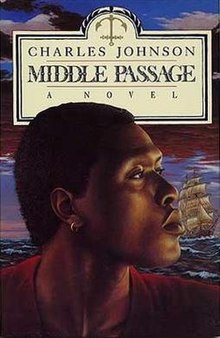
Famous First Line
"Of all the things that drive men to sea, the most common disaster, I've come to learn, is women."
The author of Middle Passage is Charles R. Johnson. He was born on April 23, 1948. Johnson is an African American author with multiple awards. He went to Stony Brook University Southern Illinois University in Carbondale. Middle Passage was published in 1990.
This book follows the story of Rutherford Calhoun, a freed slave in America. He boards a ship as a stowaway to avoid being forced into a marriage. The ship, called the Republic is an illegal slave ship headed towards Africa. He is discovered and made to work on the ship, and is fully exposed to the hardships of slave life. Calhoun becomes humbled by his experiences with the captured African slaves and learns many lessons. By the end, the Republic is falling apart and only five people survive to be rescued. Calhoun eventually makes peace with his life and his internal conflicts.
I'm not entirely sure whether or not I'd enjoy reading this book. I'm not a huge fan of historical fiction, especially if it's based on modern history. However, despite my general aversion to historical novels, this book sounds intriguing and I'd be willing to give it a try. The plot line seems very interesting, and the mystical touch of the alleged Allmuseri god is appealing to me.

Famous Last Line
"He was soon borne away by the waves and lost in darkness and distance."
This is the last line of Mary Shelly's Frankenstein, published in 1818. Shelly was an English novelist. She was born on August 30, 1797, and died on February 1, 1851.
This novel is an example of Gothic literature. A monster, created by Dr. Frankenstein, is shunned by society and even his maker. He yearns for nothing more than to be accepted, and when this desire goes unrealized, he becomes a murderer, killing his maker's loved ones one by one.
I read this book at the beginning of this year for my AP English Literature class. I did not particularly enjoy reading it. I don't find Gothic literature appealing. However, the ideas and themes within the book were interesting, and I immensely enjoyed discussing them in class. The only roadblock for me was the writing style. However, definitely worth the read.
Thursday, February 12, 2015
Memorable Quotes
Sons of Gondor! Of Rohan! My Brothers.
I see in your eyes the same fear that would take the heart of me.
A day may come when the courage of Men falls, when we forsake our friends and break all bonds of fellowship.
But it is not this day.
An hour of wolves and shattered shields when the Age of Men comes crashing down.
But it is not this day.
This day we fight! By all you hold dear on this good earth, I bid you stand, Men of the West!
 ~J.R.R. Tolkien, The Return of the King
Visit either you like: they're both mad.'
'But I don't want to go among mad people,' Alice remarked.
'Oh, you can't help that,' said the Cat: 'we're all mad here. I'm mad. You're mad.'

"Go on, admit it, the book whispers its story to you at night." "Sometimes, yes," Meggie had said
Sometimes, you read a book and it fills you with this weird evangelical zeal, and you become convinced that the shattered world will never be put back together unless and until all living humans read the book. And then there are books...which you can’t tell people about, books so special and rare and yours that advertising your affection feels like a betrayal.

I see in your eyes the same fear that would take the heart of me.
A day may come when the courage of Men falls, when we forsake our friends and break all bonds of fellowship.
But it is not this day.
An hour of wolves and shattered shields when the Age of Men comes crashing down.
But it is not this day.
This day we fight! By all you hold dear on this good earth, I bid you stand, Men of the West!
Visit either you like: they're both mad.'
'But I don't want to go among mad people,' Alice remarked.
'Oh, you can't help that,' said the Cat: 'we're all mad here. I'm mad. You're mad.'
~C.S. Louis, Alice in Wonderland
"Go on, admit it, the book whispers its story to you at night." "Sometimes, yes," Meggie had said
~Cornelia Funke, Inkheart
Sometimes, you read a book and it fills you with this weird evangelical zeal, and you become convinced that the shattered world will never be put back together unless and until all living humans read the book. And then there are books...which you can’t tell people about, books so special and rare and yours that advertising your affection feels like a betrayal.
~John Greene, The Fault in Our Stars
Do not cringe and make yourself small if you are called the black sheep, the maverick, the lone wolf. Those with slow seeing say a nonconformist is a blight on society.
But it has been proven over the centuries, that being different means standing at the edge, means one is practically guaranteed to make an original contribution, a useful and stunning contribution to her culture.
When seeking guidance, don't ever listen to the tiny-hearted. Be kind to them, heap them with blessings, cajole them, but do not follow their advice.
If you have ever been called defiant, incorrigible, forward, cunning, insurgent, unruly, rebellious, you're on the right track.
Wild Woman is close by.
If you have never been called these things, there is yet time. Practice your Wild Woman.
~ Clarissa Pinkola Estes
Memorable Passage
“If you take a book with you on a journey," Mo had said when he put the first one in her box, "an odd thing happens: The book begins collecting your memories. And forever after you have only to open that book to be back where you first read it. It will all come into your mind with the very first words: the sights you saw in that place, what it smelled like, the ice cream you ate while you were reading it... yes, books are like flypaper—memories cling to the printed page better than anything else.”
~Inkheart, Cornelia Funke
This passage stands out to me every time I read this book. I think I remember it so well because it's true and very easy to relate to. Every time I read a book, I feel like those memories stay in the book. Then, when I open it again, I remember exactly what I was doing while I was reading those words. One of my favorite books contains a memory from when I was traveling through the Catskill mountains. I remember the song that was playing, and the cool feel of the mist drifting in through the windows. Inkheart itself calls to mind the taste of rich dark chocolate with hints of zesty oranges, and People of the Wolf reminds me of warm sun and cool winds in Wyoming, sitting in my hammock on the top of a gorgeous bluff over a lake. Forever in my mind, certain memories and certain passages from books will be forever linked together. When I read this, I just remember thinking, "Yes. This is it. That's exactly what happens, this is perfect." I was so happy to finally see that in words, because I'd always felt it but was never able to explain the phenomenon. Maybe you've noticed before how a book will get thicker every time you read it. The pages somehow seem to expand out, and spaces grow between them each time you read it. This is because of the memories caught and pressed between the pages, there for you to find again and again among the words of the book.

Wednesday, February 11, 2015
Writers as Readers
When I read, I find that I am most comfortable in a quiet place. Loud sounds, like my siblings playing our out of tune piano downstairs, irritate and distract me and keep me from delving fully into the story. Aside from silence, I like to be in some place where I can just curl up for a few hours. Usually, this means my bed or my hammock, which I keep set up in the back yard. I quite enjoy having a cup of hot tea beside me when I read, and a bit of chocolate never hurts either. In all, I like to have a relaxing, calm environment when I read. It helps me zone out so I can get drawn into the story.
I think I write quite a bit like Cornelia Funke at times. She has a tendency to describe some scenes and people with great detail, pointing out small things to paint a more vivid scene just as I do. We also both use a lot of metaphors in our descriptions. I read her books a lot as a kid, and I still read them fairly regularly. I always loved them and the descriptions in them, so I think I probably picked up a bit of her writing style through this repetitious reading. I try to avoid emulating any writers. I want to have a style all my own, although I will admit if a piece of my writing sounds like someone else. I think it’s hard to completely avoid echoing others’ writing styles.
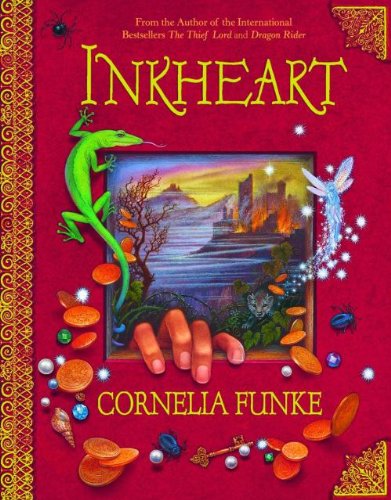
It’s nearly impossible to pick a favorite book or series. I simply love far too many. However, Tolkien and Funke have got to be my favorite two authors. I simply love both of their writing styles. Every word of theirs just sounds like poetry to me, and their stories pull me in like a black hole of words. I become so completely immersed in their books, and not only can I not pull myself back out, but I find that I don’t want to. I love being pulled in and taken into another world, and both these authors do that so masterfully. I can’t express in words just how deeply or exactly why I love the works of these authors, but all of their works mean so much to me that I know they’ll remain favorites as long as I live.
 I believe that the more someone reads, the more likely they are to become a writer. It doesn't much matter what they write, be it stories, songs, or poetry, I heavily believe that their reading habits will influence how they write. I think taking in the written words of others helps us learn how to develop our own ideas, as well as sentence structure and vocabulary. I think reading ingrains in us a love of words and makes us want to write pieces of our own, and also gives us the skill to do so.
Friday, February 6, 2015
If I Were in Charge of the World
Inspired by Judith Viorst’s “If I Were in Charge of the World”
If I were in charge of the world
I’d cancel frivolous television shows,
Electronic books,
Insipid modern music, and also
Possibly the Laws of Physics.

If I were in charge of the world,
there’d be fewer city lights,
darker nights, and
brighter stars.
If I were in charge of the world
you wouldn't have hatred.
You wouldn't have jealousy.
You wouldn't have judgement.
Or “Don’t climb that building!”
You wouldn't even have unclimbable buildings.

If I were in charge of the world
a fresh baked chocolate scone
and a cup of tea would be a vegetable.
All coffee would be black,
And a person who sometimes forgot to love
and sometimes forgot to smile
would still be allowed to be
in charge of the world.
Subscribe to:
Posts (Atom)